

Welcome to the Blog Tour for Survival Secrets by Lana Christian, hosted by JustRead Publicity Tours!
About the Book
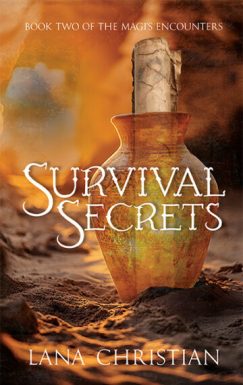
Survival Secrets by Lana Christian
Series: The Magi’s Encounters – Book 2
Publisher: Scrivenings Press
Release Date: September 23, 2025
Genre: Biblical Fiction
On the run from Herod and the Nabataeans, Akilah makes a desperate decision to venture into the unforgiving Wilderness of Paran. To reach Egypt’s safety, his caravan must survive the elements while maintaining their anonymity and protecting the secrets they harbor. Their knowledge of Yeshua is one of many secrets that jeopardize their lives. When calamity tears one Wise Man away from the others, the group’s resolve and newfound faith start to crumble. Farther from their goal of returning to Persia than ever before, they encounter Yeshua’s family again. Its ramifications raise the stakes for their cost of belief in the Hebrew God.
Two thousand miles away, Akilah’s estranged cousin, Farzaneh, wrestles with the same as she tries to uncover secrets her husband took to the grave when he embraced the Hebrew faith. As life shifts radically for everyone, each person must risk trusting an unfathomable, sovereign God.
More in This Series

About the Author

Lana Christian is an award-winning author in business and creative writing. Since 2021, she has won a dozen awards for her biblical fiction and nonfiction. Her debut biblical fiction novel, “New Star,” has garnered six awards to date. She was a 2025 Selah Awards finalist in the Devotions Online category and also won an award from Baker Publishing Group for her short story about Lot. Lana is a science and history geek who loves hiking, secret staircases, and masala chai tea. Her greatest desire is that her stories will immerse readers in another place and time they may know little about but come away with an experience that exceeds their expectations.
Connect with Lana by visiting lanachristian.com to follow her on social media or subscribe to email newsletter updates.
Author Q&A
CB: Lana, it’s great to meet you! I really appreciate that you took time out of your busy schedule for this interview.
LC: Thank you! Happy to do so!
CB: What does a normal writing day look like for you?
LC: By day I’m a medical writer. I write medical journal articles, healthcare PR, grant applications, patient education materials, and so on. That’s a very deadline-driven job. After crushing on that, I write biblical fiction in the evening or on the weekends. I don’t set a schedule for the latter or hold myself to a certain number of words or pages per day; that would be too stressful. I just make sure I’m doing something on my book(s) every day—if not actual writing, then researching, plotting, sketching scenes, and so on. And I try to take advantage of any day where I have big chunks of time free to write my novels.
CB: What inspires you most when you sit down to write?
LC: God. (Seriously!) It’s a privilege to co-create with Him. I can’t count how many times He’s brought to mind something I never would have thought of on my own in my plots. Similarly, while researching, I’d find something interesting but not useful, so I’d file it away. Six months later, it would become integral to the book. I don’t want to oversimplify things because writing is hard work. But I show up, pray, do my “homework” with character development, plotting, and such—then things “happen.”
CB: When you write Biblical fiction, how do you decide which parts of the Bible to keep exactly as written and which parts you can expand with imagination?
LC: I never take liberties with direct quotes by anyone in the Bible, specific dates or locations mentioned, and so on. Whenever I mention a king, country, culture, religion, or geographic region, it’s all true to the Bible as well as history. But I can comfortably expand on select elements. For example, the Bible records the Wise Men dining with Herod and describes the most important things that happened that evening. I can create conversation for that evening based on what we know from Scriptures, history, and archaeology—including Herod’s persona, what his Jerusalem palace complex looked like, and how he tried to straddle Jewish and Roman cultures. We don’t know how many Wise Men there were or their names. I keep it to the traditional three so my readers won’t need a spreadsheet to remember them. The names I chose for them are a sort of Easter egg—they mean “wise” in each person’s first language. We don’t know explicitly what dangers the Wise Men faced in their travels; but the Bible, history, and geography give us a good idea of those challenges. We don’t know anything about the Wise Men’s families, so the orbital characters I created as family members represent certain themes I want to reinforce in the books.
CB: What is your process for blending historical research with Scripture so the story feels both true and engaging?
LC: The biblical narrative is always my north star. I don’t deviate from what it says. But the Bible tells us what people did without usually telling us why they did it. So a big question for me is what influenced and motivated my characters? To learn that, I dig into first-century historical records. The Roman and Parthian Empires were fighting to be the world’s preeminent superpower. Then there was the mysterious Nabataean kingdom, third-largest in the area. At different times, all three sides supported—or opposed—the Jews. Against that backdrop, how did culture, religion, laws, and such affect the Wise Men’s choices and behaviors? Uncovering those historical details fleshes out the characters in an authentic way and makes their story come to life.
CB: How do you know when to stop adding details that are not in the Bible so the story does not go beyond what Scripture allows?
LC: God never asks us to do anything that would contradict his Word. Similarly, I make sure my characters don’t do or say anything that would contradict what we know about them from Scripture. We know about the Wise Men from Matthew 2. We know about Magi society from Ezra, Daniel, and world history. We know the Wise Men didn’t have access to all the prophecies about the Messiah—most notably, the Micah prophecy that pinpointed Yeshua’s birthplace. We know about Herod and his family from numerous Scriptures and first-century historians. The world missed Yeshua’s birth and disagreed on what kind of person the Messiah would be, despite the prophecies in Isaiah and other Old Testament books. All of that provides tension that is true to culture, history, and the Scriptures.
CB: Were there any “aha” moments in Scripture that opened up the story for you?
LC; The Wise Men’s story is so iconic and steeped in tradition that it’s easy to gloss over what the Bible says about them. So I start my research with praying over and rereading those Scriptures—a hundred times or more—to glean truth that I might overlook otherwise. For example, if you read Matthew 2 carefully, you’ll realize they saw the star only twice—once in their homeland, and once when they were a mile or two away from Bethlehem. That puts their story in a whole new light! No scholar in their right mind would have studied an anomalous “star” they couldn’t track. But when they did, they got in trouble with religious and governmental leaders. Another example: Matthew 2:12 simply ends with “they returned home by another route.” That sounds innocuous. But in those days, all Roman roads had watchtowers and sentries every ten miles so they could patrol for runaway slaves and criminals. The Wise Men would have been very familiar with those stations and their purpose. When the Wise Men didn’t return to Herod, he would have issued an edict for those soldiers to haul the Wise Men back to Jerusalem in chains. So where did they go? Both roads and geography limited their choices. Those kinds of details create aha moments—and then the Wise Men become 3D real people with a compelling story to tell.
CB: What first made you want to write about the Wise Men
LC: A live Nativity I watched online December 10, 2017. This may sound corny, but it was like God shined a light on each part of that Nativity, starting with the star. Then He whispered in my ear, “There’s a story to tell here.”
CB: How do you hope readers will connect with Akilah and Farzaneh’s struggles?
LC; I hope they’ll relate to how both characters experience faith as a process—because it is. When the disciples said to Jesus, “Increase our faith,” they acknowledged that faith comes from God, not their effort. The Greek word “increase” is the root of our English word “prosthesis.” That’s beautiful because a prosthesis adds to something to make it stronger and more functional. Like faith, forgiveness and reconciliation aren’t “one-and-done” things. Readers will appreciate that those struggles don’t get worked out quickly or tidily in the book. Put differently, faith, forgiveness, and reconciliation are like laying train tracks. God builds on them incrementally over time. Akilah and Farzaneh’s arcs demonstrate that.
CB: Your story shows both faith and doubt. Why was it important to include both?
LC: > First, because it’s real life. Faith doesn’t travel in a straight line. Faith can be a zigzag, sometimes stutter-stepping journey.
> Second, even the most stalwart believers experience times of doubting. Sarah. Moses. Elijah. Jeremiah. The disciples. (The list goes on.) Some people think that’s a sign of weakness, but it’s not. It’s part of the “working it out” process of trusting God.
> Third, when we have faith but bad things still happen, we shouldn’t get trapped into thinking maybe God wasn’t big enough to handle ___ [fill in the blank]. It’s a common response because at times the world presses in hard on us. But God is greater. He is more than able to handle all our questions, fears, and doubts.
CB: What do you hope readers carry with them after finishing this book?
LC: > Several things:
> What God brings you to, He will see you through.
Time and again, the Bible depicts people drawn into wilderness circumstances for a time of testing and refining. The Wise Men experience that in Survival Secrets as they flee from Herod and other enemies.
> If we give God space to work through our struggles, He will show up in ways we can’t imagine and will do things we can’t engineer on our own. (See Isaiah 64:3-4.)
> Our insufficiencies should point us to our all-sufficient Heavenly Father.
> God is the God of Hope, even during our darkest hours.
CB: Thank you again for taking the time to show us more about you and Survival Secrets. I wish you the best of luck on your book journey and pray that the Lord will continue to bless you in this ministry.
LC: Thank you for hosting me!
Lana
Tour Giveaway
1) winner will receive a $15 Amazon gift card & Plum Deluxe tea sampler*
(1) winner will receive a $15 Amazon gift card
**tea sampler will include a packet of each of the following Plum Deluxe teas:
No Obligations Decaf (a hazelnut almond black tea and author’s fave)
Comfort Blend Cinnamon Orange black tea (caffeine)
Magical Butterfly Herbal tea (butterfly pea flower + berries)
(a close substitution may be made if one kind of tea is not available)

Full tour schedule linked below. The giveaway begins at midnight September 29, 2025 and will last through 11:59 PM EST on October 3, 2025. Winners will be notified within 2 weeks of close of the giveaway and given 48 hours to respond or risk forfeiture of prize. US only. Void where prohibited by law or logistics.
Giveaway is subject to JustRead Publicity Tours Giveaway Policies.
Follow along at JustRead Tours for a full list of stops!


 Carla's Book Crush
Leave a reply to Mike Law Cancel reply